Why Logging In Correctly Matters: A Practical Case Study of OKX Login, Futures, and Spot Trading Risks

Surprising stat to start: a majority of account compromises on exchanges are not due to a mysterious backend hack but to L1 operational failures—weak credentials, misplaced 2FA methods, or careless browser extensions. That matters because on a platform like OKX—where you can switch within minutes from spot to 125x-leveraged perpetuals—the cost of a single compromised session can be catastrophic. This article walks through a concrete case: an experienced U.S. trader who needs to access OKX, move between spot and futures, and manage custody risks. The goal is not to sell you on OKX but to show the mechanisms, trade-offs, and hard limits that shape secure, practical behavior.
We’ll use that case to reveal three lessons you can reuse: how the login surface interacts with custody choices, why futures amplify operational risk, and which procedural controls (and limitations) actually reduce harm. Along the way I’ll explain important platform capabilities—spot, margin, perpetuals and the Web3 wallet—and point out where the system breaks under realistic stress.
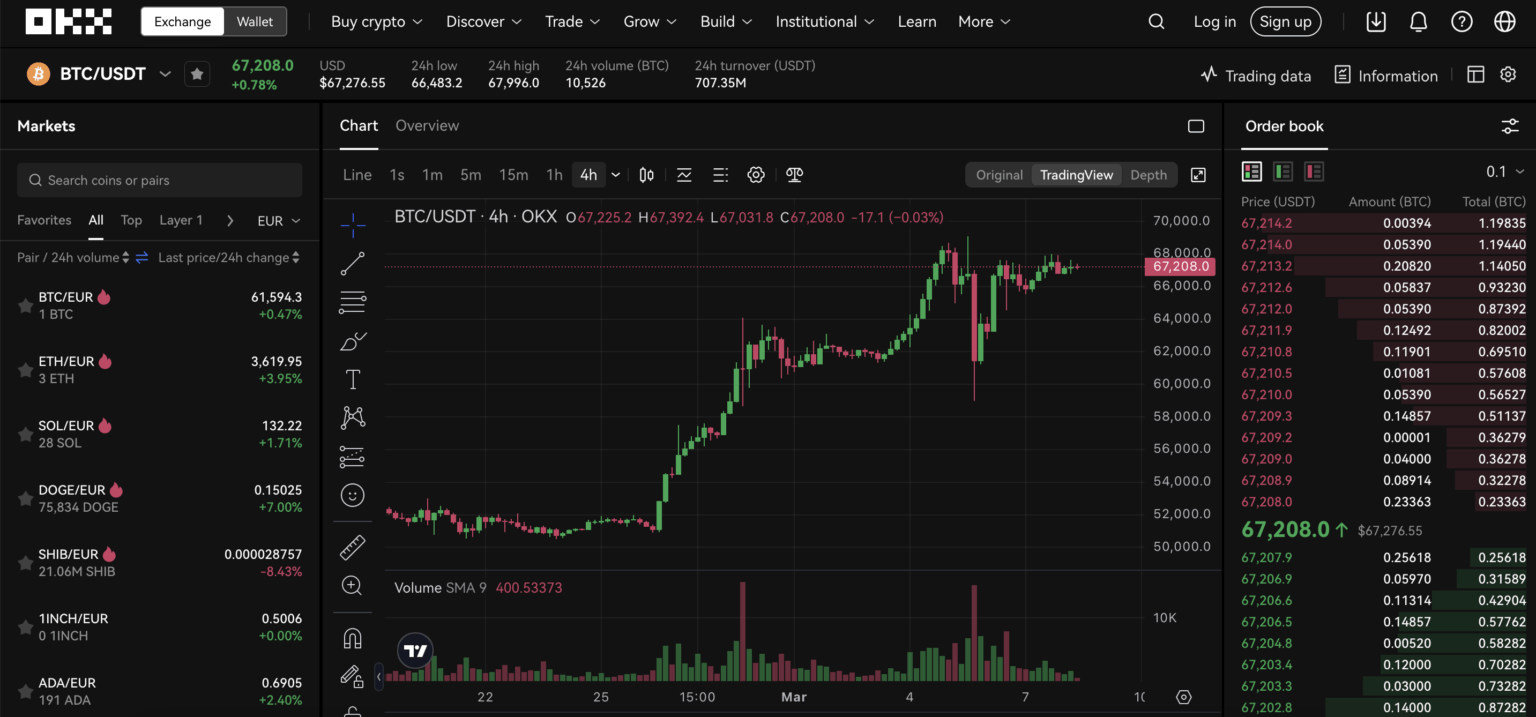
The scenario: U.S. trader, two accounts, and a high-stakes session
Imagine Jenna, a U.S.-based quant trader. She keeps a spot portfolio for long-term holdings and a separate account allocation she uses for short-term futures trades. Today she needs to do three things: log into OKX on a new laptop, move $10,000 in USDC from spot to margin, and open a short on BTC perpetual with 50x leverage. Each step sounds routine, but the mechanisms beneath matter.
First mechanism: OKX enforces KYC and multi-factor protections. For U.S. residents the KYC (government ID + liveness check) ties an identity to the account and is a gating factor for fiat rails and certain derivatives. Second mechanism: login state interacts with device trust—biometrics on mobile, browser extension tokens, or WebAuthn keys affect how OKX recognizes machines and whether it triggers extra checks. Third mechanism: moving between spot and futures often simply requires an internal transfer, but margin and leverage multiply both market risk and operational risk: you are now exposed to liquidation paths and funding-rate mechanics.
Login mechanics and where security friction helps
How the login actually works on OKX matters for risk control. Typical flows include password + 2FA (Google Authenticator or SMS) and device trust. OKX also offers biometric logins on mobile and AI-driven threat detection that can flag unusual sessions. For users who prefer Web3 custody, OKX provides a non-custodial wallet and browser extension that uses seed phrases or hardware wallets.
Those are strengths, but each introduces trade-offs. Biometric login is fast and reduces phishing success on mobile, yet biometrics are not a secret—device compromise or OS vulnerability can leak session tokens. SMS 2FA is familiar but prone to SIM swap attacks. Authenticator apps are generally stronger but rely on safe backup of secret seeds: a lost authenticator or phone can lock you out. Hardware keys (like WebAuthn) provide the best balance for web logins, but they add friction and cost.
One pragmatic rule from Jenna’s case: protect the account that holds collateral for futures more strictly. Use a hardware-backed 2FA and separate device where possible. If you must use a browser for TradingView charting and order entry, keep that browser profile isolated—no general browsing or extensions that request broad permissions. This reduces the attack surface where malicious scripts or phishing injections can intercept session cookies.
Futures on OKX: leverage is a multiplier, not just a feature
Mechanism-first: OKX offers perpetual swaps, quarterly futures, and options with leverages up to 125x on some assets. Leverage changes risk geometry. On spot, a 10% adverse price move reduces your capital by 10%. On 50x leverage, that same move wipes you out and triggers liquidation mechanics that interact with order book liquidity and funding rates.
Two practical consequences. One, operational latency matters: if your device is slow, your order cancels, or your 2FA experience stalls in a high-volatility window, price moves can create slippage and partial fills. Two, margin calls are automatic; you lose agency when the engine executes. Those losses are not theory—when the market gaps or liquidity thins, slippage widens and liquidations cascade.
A common misconception is that high leverage is manageable with close monitoring. It is, but only if your login and device stack are robust and deterministic under load. If you use a mobile biometric login for quick entries, consider switching to a hardware-backed web session when managing large positions. Remember: the worst time to debug login issues is during a market move.
Spot trading, liquidity, and delisting implications
Spot trading is the foundation: buy and sell at present market prices, or use margin to borrow up to 10x. Spot is lower operational intensity than futures, but not risk-free. Slippage on low-volume tokens, wide bid-ask spreads, and delistings can surprise traders. For example, OKX recently announced the delisting of several spot pairs—an ordinary maintenance step but one that can trap positions in illiquid markets if you hold small-cap tokens.
For U.S. traders, the takeaway is to treat spot holdings with a liquidity map: rank each asset by average daily volume, exchange depth, and cross-listing. If you plan to use a spot position as collateral for margin or futures, ensure it is highly liquid; otherwise, liquidation algorithms may sell into thin markets and cause outsized losses. That’s a limit many overlook: collateral is only as good as its marketability under stress.
Custody choices: central exchange vs non-custodial wallet
OKX blends centralized exchange services with a self-custodial Web3 wallet and hardware integrations. The core security trade-off is custodial convenience versus self-custody control. Central custody (OKX CEX) offers cold storage for most assets—OKX stores over 95% of assets in multi-sig cold wallets and publishes Proof of Reserves—meaning the platform can be resilient to external hacks. But central custody places trust in the exchange operations and KYC procedures.
Non-custodial wallets give you full control of private keys and reduce counterparty risk, but they transfer responsibility entirely to you: lost seed phrases equal permanent loss. For active derivative trading, most users keep margin collateral on-exchange for speed; for long-term spot holdings, segregating assets into a hardware wallet reduces systemic exposure. Jenna’s pragmatic split: keep day-trading capital on the exchange with strict login hygiene, and vault long-term holdings in a hardware wallet integrated via OKX’s wallet when necessary.
Note the boundary condition: some DeFi bridges and DEX aggregator actions (OKX DEX aggregator sources liquidity across Uniswap and others) expose users to smart contract risk and bridging failures. That is a distinct risk class from CEX operational risk and should be evaluated separately.
Concrete checklist: operational habits that reduce login and trading risk
From the case, here are decision-useful heuristics:
- Segment accounts and devices: dedicate one hardened device for significant collateral and high-leverage sessions; use another for casual browsing.
- Prefer hardware tokens or WebAuthn over SMS for high-privilege accounts; keep backup methods in a physical, secure location.
- Use OKX’s device management and session logs to revoke stale sessions; enable withdrawal whitelists where possible.
- Before moving spot to margin, check liquidity and recent trade volume; avoid using illiquid tokens as collateral.
- Practice emergency operations: know how to withdraw to a hardware wallet quickly and test small transfers regularly.
These are not perfect—hardware keys can be lost, and cold storage transfers are slow—but they change the failure modes from “sudden catastrophic theft” to “recoverable operational errors.”
What to watch next (near-term signals)
Three near-term signals matter for U.S. traders on OKX. One, delistings—like the recent removal of RSS3, MemeFi, GHST, RIO, and SWEAT pairs—are routine but tell you the exchange is actively pruning low-liquidity markets. If you trade niche tokens, track delisting notices. Two, regulatory posture: KYC and AML controls determine which derivatives products U.S. users can access; policy changes could narrow access to certain leveraged products. Three, product innovation such as improved Web3 wallet integrations or hardware-backed WebAuthn logins will reduce friction but may also shift attacker focus to hardware supply chains. Each signal suggests different operational responses: diversify custody, reduce leverage during periods of regulatory change, and monitor device supply chain integrity.
FAQ
How should a U.S. trader balance using OKX’s Web3 wallet versus the centralized exchange?
For U.S. traders the practical balance is simple: use the centralized exchange for active trading and low-latency margin/futures needs, and move long-term holdings to self-custody (hardware wallet) for storage. This minimizes counterparty exposure while preserving execution speed. Remember that withdrawing from a CEX to a hardware wallet incurs on-chain fees and time; practice the transfer process before large moves.
Does enabling biometrics on mobile reduce security risk?
Biometrics reduce phishing risk and speed up access on trusted devices, but they are not a complete defense. Device-level compromise, OS vulnerabilities, or backup sync services can expose biometrics-derived tokens. Treat biometrics as part of a layered strategy—not a single point of trust—and combine them with hardware-backed 2FA for accounts that hold significant collateral.
What are the most common operational mistakes that lead to losses when trading OKX futures?
Common mistakes include over-leveraging, using illiquid tokens as collateral, not testing withdrawal procedures, and mixing browsing habits with trading sessions on the same device. Technical issues during volatile markets—slow 2FA, outdated browser extensions, or unexpected delistings—also cause losses. Each is addressable through process discipline and a simple contingency plan.
Final practical note: if you’re ready to log into OKX, map your devices, elevate controls for accounts used with derivatives, and test your recovery paths now—before a market move forces you to improvise. For a direct starting point to the exchange’s login and web options, consider visiting the OKX web login guidance page: okx.
In short: login is not a nuisance—it’s the gate that determines which risk model you inhabit for the rest of your session. Treat it as your primary control, and structure trading around the limitations it imposes rather than assuming flawless operation in crisis.
Whether you’re opening a spot position, moving collateral, or taking a leveraged futures bet, the safer path is predictable processes, tested recoveries, and an honest accounting of what can go wrong. That trade-off—speed versus control—will determine how long you survive in markets designed to be unforgiving.